In a case that has sent shockwaves through Nigeria’s banking sector, United Bank for Africa Plc (UBA) finds itself embroiled in a legal battle over allegations of a secret “ghost” corporate account allegedly operated without consent. The case, filed at the Federal High Court, Lagos, paints a picture of alleged banking misconduct running into billions of naira.
EFFDEE Nigeria Limited and its Managing Director, Mr. Fouad Anthony Aquad, have dragged UBA before the court, claiming that the bank illegally opened and managed a corporate account in the company’s name. The lawsuit alleges that more than N5 billion was transacted through this account, including a controversial N2 billion loan.
In Suit No: FHC/L/CS/775/2025, the plaintiffs accuse UBA of breach of contract, negligence, breach of trust, identity theft, unlawful data processing, and violation of constitutional rights to privacy. They are seeking substantial damages, alongside declaratory and injunctive reliefs.
EFFDEE Nigeria Limited insisted that it has maintained only one legitimate corporate account with UBA since August 4, 2020. The company claimed it never applied for, authorized, or consented to the opening of any other account.
The alleged misconduct reportedly came to light in January 2025 when the Federal Inland Revenue Service (FIRS) contacted Mr. Aquad during a tax investigation. FIRS requested statements for two UBA accounts supposedly belonging to the company, one of which was completely unknown to the plaintiffs.
Alarmed, the company conducted internal checks and discovered the existence of a second UBA account described in court documents as an “illegal account.” According to the plaintiffs, this account had been operated without their knowledge for several years.
Statements obtained from UBA reportedly showed that the disputed account opened with a balance of N2 billion, claimed to be a loan, and recorded cumulative transactions exceeding N5.2 billion between 2020 and 2022. Subsequent transactions allegedly continued between January 2023 and January 2025.
The plaintiffs maintain that neither director applied for the account, signed any mandate, submitted identity documents, passed board resolutions, or authorized any related transactions. They argue that the account’s existence exposed Mr. Aquad to unwarranted law enforcement scrutiny.
In August and September 2024, the Economic and Financial Crimes Commission (EFCC) allegedly invited, detained, fingerprinted, and questioned Mr. Aquad regarding the disputed transactions and the N2 billion facility linked to the account. He insists he had no knowledge of it.
EFFDEE Nigeria Limited claims that UBA unlawfully used confidential corporate and personal information from the legitimate account to operate the second account. The plaintiffs allege signature forgery, document cloning, and neglect of mandatory anti-money laundering checks.
While the purported illegal account allegedly ran uninterrupted, UBA is accused of restricting the company’s legitimate account in September 2024 due to “incomplete documentation.” The plaintiffs describe this as suspicious and indicative of internal control failures.
The suit further accuses UBA of violating the Banks and Other Financial Institutions Act, Central Bank of Nigeria regulations, the Nigeria Data Protection Act 2023, and the Federal Competition and Consumer Protection Act. Plaintiffs say the bank interfered with their constitutional right to privacy under Section 37.
EFFDEE Nigeria Limited is seeking a court declaration that the disputed account was unlawfully opened, billions in damages—including N3 billion in aggravated damages—and perpetual injunctions barring UBA from further operating the account or using their data.
The company also alleges that despite repeated letters and a pre-action notice through lawyers, UBA failed to provide a satisfactory response or take corrective action.
UBA, however, has denied the allegations and urged the court to dismiss the suit. At the last hearing, UBA’s counsel, B. Nwokedi, told the court that the principal was out of jurisdiction, prompting a request for adjournment.
Category: Brands
-

UBA Faces N5 Billion Notorious Legal Mess Over Alleged “Ghost” Corporate Account
-

Leo Stan Ekeh: A “Rare Avis”, an unconquerable Entrepreneur* TIm Akano
Leo Stan Ekeh, LSE is an extraordinary human being. He is extremely hardworking, hugely brave, and massively intelligent. He is a shrewd businessman but with a cathedral-size heart of butterfly*I’m a product of LSE’s generosity. But not only me, I am close enough to know. We are uncountable.I was always with him after office hours in his office twenty years ago when he was constructing a church in his place of birth. He was so committed to details and beauty that when the church was roofed and he went for inspection and discovered some misalignment, he instructed the contractor to remove the roof and redo it, without minding the extra cost coming from his pocket.There was this physically challenged fellow that LSE bought a car for, including a driver to make life easier for her.During one of his birthday celebrations, he told me, *Tim, I am not inviting my friends for any birthday party this year, all the money I would have used in buying expensive wine, I am donating everything to charity**LSE & I*He actually looked for me when I started New Horizons. He read my interview in the Vanguard news paper and asked his staff to look for me.*Prayer*:May each of us receive a telephone call before the end of 2025 that will change our life’s trajectory for good for ever in Jesus name, Amen.I did.!Our conversation on that fateful Friday went like this:*LSE*: Tim, I read your interview in the newspaper. I would like us to meet.*Tim*: You are our LEADER in the Technology ecosystem, Sir.I can come to your house tomorrow Saturday morning for a breakfast.*LSE*: Tim, that’s good, I will be expecting you by 8am tomorrow in my house.By 8am the following day, I was in his massive, intimidating house.As I entered the premises I said a simple prayer: *The God Almighty who is blessing LSE, please Daddy God be kind to me also in my entrepreneurship journey* Amen.That day the breakfast meeting went well. He wanted to see the man behind the ambitious vision of transforming the ICT education in Nigeria.He saw tomorrow!1 *LSE First Intervention* Two years after I started my company, New Horizons, I ran out of cash, even to pay salary was a prayer item every 30th of the month. That was May, 2007 *it remained just 72 hours for Heaven to fall on my head, metaphorically speaking, that is*!I needed N10M to stop HEAVEN FROM CRASHING ON MY HEAD!Banks in Nigeria are irrelevant to Start-ups, except and until you START WALKING, Banks will not come to your assistance in Nigeria.It is O.Y.O (On Your Own) for every Start-up. If you don’t have God 100% on your side, don’t dabble into entrepreneurship in Nigeria!This is why over 80% of Start-ups failed in Nigeria. In America, it is about 50%.LSE was in Abuja on this particular Thursday. I called him and requested to see him. He told me to come.Our conversation went like this:*LSE*: Tim, I know you are keeping well.*Tim*: My chairman, I am strong in faith, but in reality, *heaven is hot on my side o*! I need help, Chairman.*LSE*: What is the matter, Tim?*Tim*: I need N10M soft loan to keep afloat. It is urgent, critical and time- bound.*LSE* ok, Tim, see me on Monday (that meeting took place on a Thursday).*Tim*: My chairman, I am not exaggerating the criticality of my situation. by Monday it would be too late because *Heaven would crash on my head in another 72 hours without the N10M*! And it would be all over.LSE adjusted himself, he breathed in , he looked me straight in the eyes. I wouldn’t know what LSE saw in my eyes that day.But he stood up, went to the inner room and he came out with his cheaqe book. He gave me an Access Bank cheaqe for N10M, which I later refunded 3 months later without interest.I survived, heaven didn’t fall that day, glory be to God and thanks to LSE.*LSE intervention 2*:This time we had grown, having survived the ABIKU YEARS (The first 5 years of Start-up are the ABIKU YEARS, years of premature, sudden death. If you survive the first 5 years, your chances of living to celebrate your 20 years in business are bright). We did, all gratitude to God.I got a business that required huge capital to execute- very big money, which was beyond my capacity.I went to my destiny- helper again. He is never tired of seeing me. He picks my calls on the first ring. But I don’t abuse the access too. No frivolous conversations. No irrelevant calls. Every call is about matter and mission criticalThis particular day LSE was looking extremely tired, having over flogged his body.He told me he had been sleeping in the office for about 3 days, busy putting his papers together to enable him close a massive business deal, which he eventually got, after fighting like a lion whose cub was taken by a lone leopard!LSE overwhelmed every opposition. He fought like Mohammed Alli, the world’s greatest boxer of all time. LSE won.And that changed everything for him, too, forever. *Fortune favours the Brave*Our conversation that day went like this:*LSE*: Tim, congrats you are doing well, I can see. Indeed I instructed all my staff to make sure they read any article you published (“I felt flattered”).*Tim* : Chairman, I need your help, KONGA is not ready to give me the products I needed on credit and I don’t have cash to pay and the client will not pay me until after 9 months.Tough one, indeed.*LSE*: Tim, I will be honest with you, there is no way KONGA would give you products worth N500M (10 years ago money!) on credit.Indeed, we held a meeting on Monday over your matter, the resolution of the Zinox Group is that you must look for cash before you can get the products. Let me tell you, my staff made me to sign-off on our resolution that as the Chairman of Zinox , I, LSE will not go behind to do the opposite of what we all agreed to, and I signed. Tim, I am sorry, my hands are tied!As of that time, some of the young people LSE helped disappointed him badly. So bad, some souls are ungrateful.*Tim*: Chairman, I know some of the people you helped even went to the extent of wrongfully blackmailing you in the media. I know that for a fact.But Chairman, I am different. I am Tim Akano, I won’t disappoint you.I will remain eternally grateful if you can still think out- of -the box and help me out.I added: *Chairman, you recall you were the one who looked for me that you would give me a helping hand in life.*I think my last statement touched him.*LSE* Tim, I will give you my personal cheaqe. Here is the cheaqe for you, take it to KONGA and pay for your goods to meet your deadline.*Tim* On getting to KONGA, from my steps and tone, the staff knew something positive had happened.I confidently presented *my cheaqe* to Loretta & Co, the lady managing our account in KONGA thenThey were shell shocked that God pulled it through for me another time, using Leo Stan Ekeh.There were many more positive interventions, which I will reserve for my memoir.*Lessons*: The reason behind the rise and rise of Leo Stan Ekeh (LSE) has to do partly because of his massive generosity, most of them are done silently.Yes, LSE is a shrewd business man, but he has a heart of a butterfly.2 *LSE is unconquerable and himself and his lineage will remain so because of several lives he has impacted positively*3 We are all products of people’s generosity. No one is a self made man .In my own corner, through the *TIM AKANO FOUNDATION,* I am giving back in thousands folds all the kindness I am enjoying from people like LSE & others. I’m not withholding any kindness from people who need it when it’s within my capacity. God saw my heart, too, that when he must have helped me to stand, I will light thousands of candles.It was William Shakespeare who admonished his followers to tell him all the good things they wanted to tell him while he was still alive because tributes written in beautiful prose means nothing to a dead person.*I congratulate LSE children, they have a great father in and his legendary generosity will always speak for them up to the 4th generation.*, as the Holy Bible said. LSE children should be proud of their father, he is a Lion, an Eagle and a butterfly, (LEB) all together at the same time.*@LSE*: Sir, if you manage to read this short public appreciation, which I was inspired to write in a wedding event (the couple is taking over one hour to come out, instead of joining people who are anxious, I decided to use my idle time to pay you this tribute today), I want you to feel proud of yourself; what you have achieved will take an average person 10 lifetimes to achieve.Your positive numerous interventions in my entrepreneurship journey have germinated and I am also touching lives- like you- in thousands across Africa, not only in Nigeria, especially with regards to Youth Empowerment.I am eternally grateful, my chairman, my destiny-helper.*My prayer for you my Chairman, LSE: The Lion, the Eagle, the Butterfly (LEB) is for God to keep you continuously in sound, divine health, peace and happiness- that you will still remain strong at 120 years of age like the Biblical Moses who miraculously escaped physical depreciation in his eyes, strength and mental magnitude.*
Gratitude!Gratitude!!Gratitude!!! -

Fidelity Bank Advances Sustainable Firefighting Practices with Donation of Hoses and Water Pumps
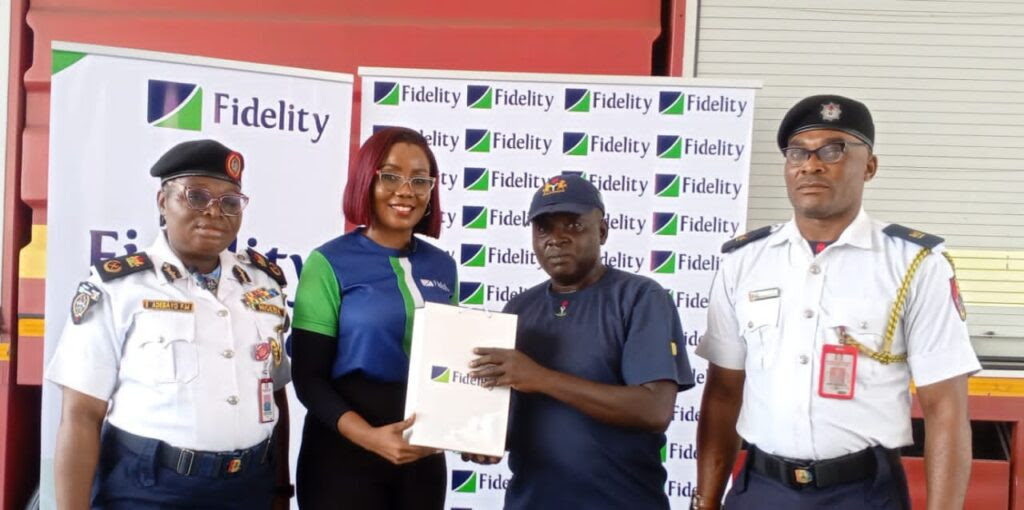
Fidelity Bank Plc has reinforced its commitment to community safety and sustainable ecological practices through the donation of essential firefighting and preventive equipment including hoses and gasoline water pumps to the Ikoyi Fire Service Station in Lagos.
The donation was made under the Fidelity Helping Hands Program (FHHP) by the True Serve team, reaffirming the Bank’s commitment to the environment and community safety. Through the FHHP, members of staff identify areas of critical community needs, raise funds, and then receive matching monetary support from the bank to execute the projects.
Commenting on the reason behind the donation, Divisional Head, Brand and Communications Division, Fidelity Bank Plc, Dr Meksley Nwagboh, emphasized that the donation reflects the bank’s dedication to strengthening emergency response capabilities and promoting public safety within the communities it serves.
According to him, “Fidelity Bank remains committed to supporting initiatives that contribute to the protection of our environment, lives and property. We see community safety as a shared responsibility and continuously extend support to both corporate bodies and individuals.”
Dr Nwagboh further noted that, “We believe that preventive measures are far more effective than reactionary responses. This donation is part of our efforts to drive sustainable practices by providing the necessary tools. Our goal is to ensure that people live meaningful, safe, and empowered lives.”
In her comments, Lagos State Controller, Federal Fire Service and Controller of Fire (CF), Funke Adebayo commended Fidelity Bank for the timely support, while cautioning residents to exercise heightened vigilance during the festive period, especially with the dry weather conditions.
“We appreciate Fidelity Bank for this timely donation. We are in a harsh weather period where fire incidents can escalate quickly. Parents must educate and caution children against the use of fireworks during celebrations. Fire should never be treated carelessly,” Adebayo said.
She noted that the Fire Service has embarked on sensitization visits to various corporate organizations, warning against unsafe practices that could lead to preventable fire outbreaks.
On his part, Area Commander, Onikan Fire Station and Chief Superintendent of Fire (CSF)Oswere Michael expressed appreciation to Fidelity Bank for supporting their operations. He encouraged families, business owners, and community members to prioritize fire safety at all times.
“Everyone has a role to play in preventing fire incidents at home and in the workplace. This support from Fidelity Bank will go a long way in enhancing our capacity to protect the community,” CSF Oswere added.
Ranked among the best banks in Nigeria, Fidelity Bank Plc is a full-fledged Commercial Deposit Money Bank serving over 9.1 million customers through digital banking channels, its 255 business offices in Nigeria and United Kingdom subsidiary, FidBank UK Limited.
The Bank is a recipient of multiple local and international Awards, including the 2024 Excellence in Digital Transformation & MSME Banking Award by BusinessDay Banks and Financial Institutions (BAFI) Awards; the 2024 Most Innovative Mobile Banking Application award for its Fidelity Mobile App by Global Business Outlook, and the 2024 Most Innovative Investment Banking Service Provider award by Global Brands Magazine. Additionally, the Bank was recognized as the Best Bank for SMEs in Nigeria by the Euromoney Awards for Excellence and as the Export Financing Bank of the Year by the BusinessDay Banks and Financial Institutions (BAFI) Awards.
-

Nigeria: Digital Economy Revenue to Top $18.30bn by 2026
L-R: Garba Kurfi, Managing Director/CEO, APT Securities and Funds Limited; Prince Cookey, Publisher/Editor-in-Chief, Business Journal Media Group; Olatunde Amolegbe, Managing Director/CEO, Arthur Stevens Asset Management Limited and Keynote Speaker; Prof. Anthony Kila, Pro- Chancellor, Michael and Cecilia Ibru University/Chairman of the Occasion; Tony Epelle, Managing Consultant/CEO, Samuelson Advisory Partners Limited and Dotun Oladipo, Managing Editor, The Eagle Online, during the Business Journal Annual Lecture 2025 on the theme: ‘AI & Digital Economy: Projecting the Future of Economic Growth in Nigeria’ in Lagos.
Mr. Olatunde Amolegbe, Managing Director/CEO, Arthur Stevens Asset Management Limited has projected that Nigeria’s digital economy revenue will reach $18.30 billion by 2026, as against $5.09 billion in 2019 and $9.97 billion in 2021.
Delivering the keynote paper at the Business Journal Annual Lecture 2025 in Lagos, Amolegbe said: “Nigeria’s digital economy is undergoing rapid transformation, positioning the country as one of Africa’s leading technology-driven markets. Global trends show the digital economy accounted for $11.5 trillion (15.5% of global GDP) in 2016, with projections to reach 25% by 2026. Aligned with this momentum, the Digital Economy for Africa (DE4A) initiative, anchored on inclusivity, homegrown innovation, collaboration and transformational scale, supports Africa’s vision of achieving full digital enablement by 2030.”
Amolegbe added that Nigeria leads Africa in start-up investment and hosts five unicorns: Interswitch, Flutterwave, OPay, Andela and Moniepoint, reflecting robust private-sector innovation, while Internet penetration reached 107 million users in early 2025, driven by mobile-first access, which now accounts for over 90% of connectivity nationwide.
He said key sectors such as telecommunications already contribute significantly, with 9.20% added to real Gross Domestic Product (GDP) in Q2 2025 while Fintech and digital payments are expanding rapidly, powered by the NIP network, forward-leaning regulations and increased consumer adoption across banking channels.
Speaking on the theme: AI & Digital Economy: Projecting the Future of Economic Growth in Nigeria, Amolegbe insisted that disruptive technologies, social media, streaming platforms, blockchain and Artificial Intelligence (AI) are reshaping Nigeria’s socio-economic landscape.
“Nigeria has demonstrated early adoption, including the launch of its central bank digital currency, the eNaira in 2021.”
The keynote speaker said major economic opportunities exist in agriculture, health, education, infrastructure and energy; sectors still lagging in technological innovation.
“AI can improve yields, strengthen healthcare delivery, expand digital learning, support smarter infrastructure planning and accelerate Nigeria’s transition to smarter and cleaner energy systems. Nigeria’s path to AI-driven digital growth is supported by strong demographics, emerging policy interventions such as NITDA’s AI Strategy and expanding connectivity through eight submarine cables totaling over 40 Tbps in capacity.”
He warned however, that to fully unlock the economic value in AI and digital economy, Nigeria must strengthen governance, talent pipelines, digital infrastructure and regional collaboration.
Key Gaps:
· Infrastructure Deficit in Rural Regions
As of August 2025, Nigeria’s broadband penetration stands at about 48.81%, well below the 70% target of the National Broadband Plan (2020–2025). Although over 45% of the population lives in rural areas, only around 23% of rural communities have internet access, highlighting a significant digital divide and widespread exclusion from digital opportunities.
· Slow Policy Harmonisation and Regulatory Bottlenecks
Despite a 2020 agreement to cap Right-of-Way (RoW) fees at ₦145 per meter, some states now charge as much as ₦9,477 per meter (e.g., Ogun State), raising operating costs for telecom firms to a record ₦5.85 trillion in 2024 — a key factor slowing infrastructure rollout and AI adoption.
· Low Adoption of Automation in Manufacturing, Agriculture and Public Services
In Nigeria’s manufacturing industry, only about 18% of firms have fully implemented AI or automation tools, while around 43% of surveyed companies report having no automation at all. In agriculture, less than 1% of farming households own tractors, and only 6% of arable land is irrigated, indicating a very low level of mechanisation and automation adoption.
Enablers of AI-driven Digital Growth in Nigeria:
· Demographics
220M+ population (Over 50% smartphone penetration by 2025); diaspora remittances fueling tech.
· Policy
NITDA’s AI Strategy- NITDA has established itself as a link connecting local innovators with global technology influencers. A recent instance is the NITDA–Google AI Fund, which assists ten Nigerian startups with funding and technical support.
· Infrastructure
Nigeria is home to eight active submarine cables, which provide over 40 terabits per second (Tbps) of international connectivity capacity landing at its shores.
· Private Sector
Nigeria is home to eight active submarine cables, which provide over 40 terabits per second (Tbps) of international connectivity capacity landing at its shores.
“Nigeria stands at a pivotal moment where digital transformation, powered by AI and disruptive technologies can accelerate long-term economic growth and global competitiveness. The foundations for this transformation, including youthful demographics, expanding connectivity, vibrant private-sector innovation and emerging regulatory frameworks are already established. Realising this potential requires a co-ordinated, ethical and investment-driven national strategy that aligns public-sector policy with private-sector innovation. Strengthening talent development, building digital infrastructure, promoting responsible AI governance and fostering regional collaboration will be critical. With the right investments and policy direction, Nigeria can scale its digital economy, enhance productivity across key sectors, create millions of jobs and position itself as a continental leader in the AI-powered global digital economy.”
-

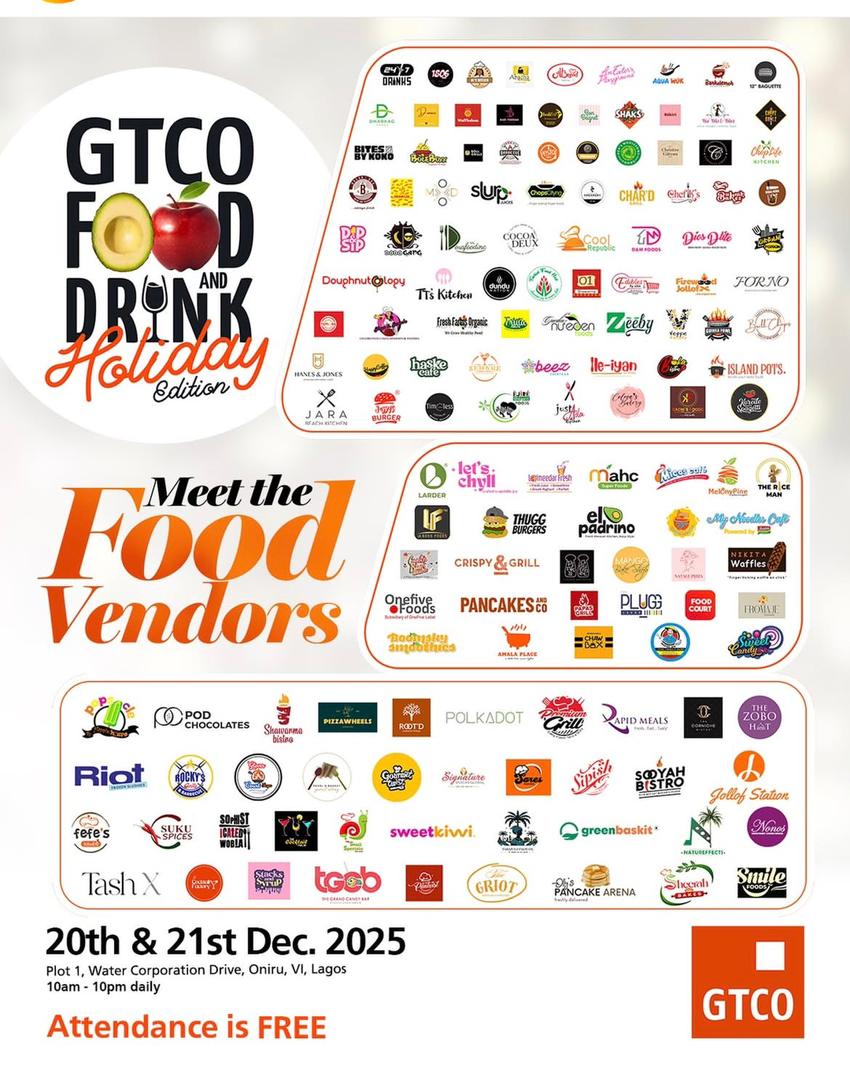
GTCO Food and Drink – Holiday Edition Kicks Off in Lagos Saturday, Promising a Festive Culinary Experience
Guaranty Trust Holding Company Plc (GTCO Plc) will tomorrow open the maiden
Holiday Edition of the GTCO Food & Drink Festival, a strategic expansion of Africa’s
largest food and beverage platform into the festive season.
The two-day event will be held from December 20 to 21, 2025, at the GT Centre,
Plot 1 Water Corporation Drive, Oniru, Lagos, running daily from 10:00am to
10:00pm, and is free and open to the public. Designed to coincide with one of the
most commercially active periods of the year, the Holiday Edition delivers a carefully
curated blend of culinary excellence, family-oriented entertainment, and enterprise
development.
The Holiday Edition reflects GTCO’s evolving approach to experience-led engagement,
placing emphasis on immersive consumer experiences while sustaining the Festival’s
core objective of supporting Nigerian food entrepreneurs. This year’s edition features
213 Nigerian-owned food and beverage businesses, selected from over 4,000
applications nationwide, reinforcing the Festival’s growing relevance as a credible
commercial platform for SMEs and a significant contributor to the creative economy.
Festival attendees can expect a diverse culinary showcase spanning traditional Nigerian
favourites, contemporary street food concepts, artisanal beverages, and modern fusion
cuisine. Notable vendors participating in the Holiday Edition include MelonyPine,
Firewood Jollof Nigeria, Dundu Nation, Polo Club Suya, Thugg Burgers, Pizzawheels,
Chow Noodle Bar, Jazzy’s Burger, 247 Drinks and 247 Cocktails, The Coconut Lady,
Pancakes & Co., Butterfly Bakery, Amala Place Canteen, Nonos Catering, Sooyah Bistro,
and Mmaabacha, among several others. Collectively, these brands represent the depth,
creativity, and commercial potential of Nigeria’s food ecosystem.
Unlike previous editions, the Holiday Edition has been intentionally structured to
prioritise festive engagement over instructional programming. The experience includes
a Christmas Village featuring curated gift items and seasonal treats, an expanded Street
Food Hub celebrating Nigeria’s street food culture, a dedicated Children’s Play Zone
designed to accommodate families, and continuous live DJ entertainment to create a
vibrant holiday atmosphere throughout the two-day event.
Speaking on the significance of the Holiday Edition, the Group Chief Executive Officer
of GTCO Plc, Segun Agbaje, noted that the Festival continues to serve as a powerful
vehicle for enterprise development while fostering shared cultural experiences. He
reaffirmed that the Holiday Edition provides an opportunity to deepen GTCO’s impact
by supporting food entrepreneurs at a peak sales period, while offering families and
communities a high-quality, accessible festive destination.
Consistent with its long-standing commitment to inclusive growth, GTCO has retained
its zero-cost participation model for vendors, ensuring that small and medium-sizedbusinesses can benefit directly from increased visibility, customer engagement, and
revenue generation without financial barriers.
The GTCO Food & Drink Festival – Holiday Edition underscores the Group’s belief that
meaningful cultural experiences, creativity, and economic opportunity should remain
accessible to all. As Lagos enters the holiday season, the Festival stands as a timely
convergence of commerce, culture, and celebration—reinforcing GTCO’s role as a
catalyst for enterprise and community connection. -

Dangote, Monopoly Power, and Political Economy of Failure BY BLAISE UDUNZE
Nigeria’s refining crisis is one of the country’s most enduring economic contradictions.
Africa’s largest crude oil producer, strategically located on the Atlantic coast and home
to over 200 million people, has for decades depended on imported refined petroleum
products. This illogicality has drained foreign exchange, weakened the naira, distorted
investment incentives, and hollowed out state institutions. Instead of catalysing
industrialisation, Nigeria’s oil wealth became a mechanism for capital flight, rent-
seeking, and institutional decay.
With the challenges surrounding the refining of crude oil, the establishment of Dangote
Refinery signifies an important historic moment. The refinery promises to reduce fuel
imports to a bare minimum, sustain foreign exchange growth, ensure there is constant
fuel domestically, and strategically position Nigeria as a regional exporter of refined oil
products if functioned at full capacity. Dangote Refinery symbolises what private capital,
technology, and ambition can achieve in Africa following years of fuel queues, subsidy
scandals, and global embarrassment.
Nigerians must have a rethink in the cause of celebration. Nigeria’s refining problem is
not simply about capacity; it is about systems. Without addressing the policy failures
and institutional weaknesses that made Dangote an exception rather than the rule, the
country risks replacing one failure with another, this time cloaked in private-sector
success.
For a fact, Nigeria desperately needs the emergence of Dangote refinery, and its
success is in the national interest. Hence, this is not an argument against the Dangote
Refinery. But history warns that structural failures are not solved by scale alone. Over
the year, situations have shown that without competition and strong institutions,
concentrated market power, whether public or private, can undermine price stability,
energy security, and consumer welfare.The Long Silence of Refinery Investments
Perhaps the most troubling question in Nigeria’s oil history is why none of the global oil
majors like Shell, ExxonMobil, Chevron, Total, or Agip has built a major refinery in
Nigeria for over four decades. These companies operated profitably in Nigeria,
extracted their crude, and sold refined products back to the country, yet never
committed capital to domestic refining.
Over the period, it has been shown that policy incoherence has been the cause, not a
matter of technical incapacity, such as price controls, resistant licensing processes,
subsidy arrears, frequent regulatory changes, and political interference, which made
refining an unattractive investment. Importation, by contrast, offered quick returns, lower
political risk, and guaranteed margins, often backed by government subsidies.Nigeria carelessly designed a system that rather rewarded importers and punished
refiners. Dangote did not succeed because the system improved; he succeeded despite
it. His refinery exists largely because of the concessions from the government,
exceptional financial capacity, political access, and a willingness to absorb risks that
institutions should ordinarily mitigate. This raises a deeper concern; when institutions
fail, progress becomes dependent on extraordinary individuals rather than predictable
systems.The Tragedy of NNPC Refineries
If private investors stayed away, Nigeria’s state-owned refineries should have filled the
gap. Instead, the Port Harcourt, Warri, and Kaduna refineries became monuments to
mismanagement. Records have shown that between 2010 and 2025, Nigeria reportedly
wasted between $18 billion and $25 billion, over N11 trillion, just for Turn Around
Maintenance and rehabilitation. Kaduna Refinery alone is estimated to have consumed
over N2.2 trillion in a decade.
Despite these expenditures, output remained negligible. This was not merely a technical
failure but a governance one. Contracts were poorly monitored, accountability was
absent, and consequences were nonexistent. In functional systems, such outcomes
trigger investigations, sanctions, and reforms. In Nigeria, the cycle simply repeated
itself, eroding public trust and deepening dependence on imports.Where Is BUA?
Dangote is not the only Nigerian conglomerate to announce refinery ambitions. In 2020,
BUA Group unveiled plans for a 200,000-barrels-per-day refinery. Years later, progress
remains unclear, timelines have shifted, and execution appears stalled.
This pattern is revealing. When multiple large investors struggle to translate plans into
reality, the issue is not ambition but environment. Refinery projects in Nigeria appear
viable only at a massive scale and with extraordinary political leverage. Smaller or mid-
sized players are effectively crowded out, not by market forces, but by systemic
dysfunction.Policy Failure and the Singapore Comparison
Nigeria often aspires to emulate Singapore’s refining and petrochemical success. The
comparison is instructive. Singapore has no crude oil, yet built one of the world’s most
sophisticated refining hubs through consistent policy, investor protection, infrastructure
planning, and regulatory certainty.
Nigeria chose a different path: price controls, subsidies, weak contract enforcement,
and politically motivated policy reversals. Refineries became tools of patronage rather
than productivity. Capital exited, infrastructure decayed, and import dependence
deepened. The outcome was predictable.The Cost of Import Dependence
For years, Nigeria spent billions of dollars annually importing petrol, diesel, and aviation
fuel. This placed constant pressure on foreign reserves and the naira. Petrol subsidies
alone were estimated at N4-N6 trillion per year, often exceeding national spending on
health, education, or infrastructure.
Even after subsidy removal, legacy costs remain: distorted consumption patterns,
weakened public finances, and entrenched interests built around importation. These
interests did not disappear quietly.Who Really Benefited from the Subsidy?
Although framed as pro-poor, fuel subsidies disproportionately benefited importers,
traders, shipping firms, depot owners, financiers, and politically connected
intermediaries. Smuggling across borders meant Nigerians subsidised fuel consumption
in neighbouring countries.
Ordinary citizens received marginal relief at the pump but paid far more through
inflation, deteriorating infrastructure, and underfunded public services. The subsidy
system functioned less as social protection and more as elite redistribution.The Traders’ Dilemma
Why did major fuel marketers like Oando invest in refineries abroad but not in Nigeria?
Again, incentives explain behaviour. Importation offered faster returns, lower capital
requirements, and political insulation. Domestic refining demanded long-term
investment under unstable rules.
In an irrational system, rational actors optimise accordingly. Importation thrived not
because it was efficient, but because policy made it so.FDI and the Confidence Problem
Sustainable Foreign Direct Investment follows domestic confidence. When local
investors, who best understand political and regulatory risks, avoid long-term industrial
projects, foreign investors take note. Capital flows to environments with predictable
pricing, rule of law, and policy consistency.
Nigeria’s challenge is not attracting speculative capital, but building conditions for
patient, productive investment.Dangote and the Monopoly Question
Dangote Refinery deserves credit. But scale brings power, and power demands
oversight. If importers exit and no competing refineries emerge, Dangote could
dominate refining, pricing, and supply. Nigeria’s experience with cement, where
domestic production rose but prices soared due to limited competition, offers a
cautionary tale.
Markets function best with competition. Without it, price manipulation, supply risks, and
weakened energy security become real dangers, especially in countries with fragile
regulatory institutions.The Way Forward: Competition, Not Replacement
Nigeria does not need to weaken Dangote; it needs to multiply Dangotes. The goal
should be a competitive refining ecosystem, not a replacement of a public monopoly
with a private monopoly.
This requires transparent crude allocation, open access to pipelines and storage, fair
pricing mechanisms, and strong antitrust enforcement. State refineries must either be
professionally concessional or decisively restructured. Stalled projects like BUA’s
should be unblocked, and modular refineries should be supported.The Litmus Test
Nigeria’s refining crisis was decades in the making and cannot be solved by one
refinery, however large. Dangote Refinery is a turning point, but only if embedded within
systemic reform. Otherwise, Nigeria risks trading one form of dependency for another.
The true test is not whether Nigeria can refine fuel, but whether it can build fair, open,
and resilient institutions that serve the public interest. In refining, as in democracy,
excessive concentration of power is dangerous. Competition remains the strongest
safeguard.
Blaise, a journalist and PR professional, writes from Lagos and can be reached
via: blaise.udunze@gmail.com -

Kano State Government Unveils Cycling Kano 2025 Jersey Ahead of Saturday’s Event
L-R: Mr Ahmed Abdulrazaq, Project Coordinator, Cycling Kano; Mr Sani Musa Danja, Senior Special Adviser to Kano State Governor on Sports and Youth Development and Mr Bamidele Adeleye, Managing Director, BrandEscort Communications at the unveiling of Cycling Kano 2025 Jersey, in Kano on Wednesday December 17, 2025.The Kano State Government on Wednesday officially unveiled the Cycling Kano 2025 jersey ahead of the highly anticipated cycling event scheduled for Saturday December 20, reaffirming the administration’s commitment to sports development, youth engagement, and the promotion of healthy living across the state.The unveiling ceremony, held at the office of the Senior Special Adviser to the Kano State Governor on Sports and Youth Development, Mr. Sani Musa Danja, showcased the vibrant jersey design and colours, which reflect Kano State’s rich cultural heritage, unity, and enduring passion for sports. The jersey will be worn by participants during Saturday’s event, which is expected to attract cyclists, sports enthusiasts, and spectators from across the state and beyond.Speaking at the unveiling, Mr. Danja described the Cycling Kano initiative as a key component of the state government’s broader strategy to promote grassroots sports development and encourage an active and healthy lifestyle among residents.“Cycling Kano is more than a sporting event; it is a movement that promotes wellness, discipline, and community bonding. The jersey symbolizes our shared identity and our resolve to position Kano as a hub for sporting excellence,” he said.The Kano State Government commended sponsors, partners, and stakeholders for their support in making the event a reality and urged residents to turn out in large numbers to participate and cheer on the cyclists.Saturday’s event is scheduled to commence at 7:00 a.m. from the Emir’s Palace in Kano, with adequate security and medical arrangements in place to ensure a safe and successful outing.Cycling Kano is a state-backed initiative aimed at promoting cycling as a competitive sport, a means of physical fitness, and an environmentally friendly mode of transportation, while fostering unity and youth empowerment across Kano State.The 2025 edition of the event, scheduled to hold on Saturday, December 20, 2025, is sponsored by the Kano State Government, Union Bank of Nigeria Plc, and NNPC, with additional support from Peak Yogurt and CWAY. -

Fidelity Bank Enhances Maternal and Child Healthcare Delivery at ESUTH
L-R: Public Relations Officer, Enugu State University Teaching Hospital (ESUTH), Amarachi Amusi; Team Member, Optimizers Inductees Class of 2025, Precious Uchechi-Uneke; Class Governor, Optimizers Inductees Class of 2025, Chinedu Hilary-Elijah (both of Fidelity Bank Plc); Matron, Children’s Ward ESUTH, Esther Nnaji; and Team Lead, Corporate Social Responsibility (CSR), Fidelity Bank Plc, Victoria Abuka; during the Fidelity Helping Hands Program (FHHP) outreach to ESUTH recently.Fidelity Bank Plc has brought relief to indigent patients at the Enugu State University Teaching Hospital (ESUTH) Parklane, by offsetting medical bills and providing financial support to children battling chronic health conditions alongside donations of ante-natal kits to pregnant women.The intervention, which was carried out under the bank’s Corporate Social Responsibility (CSR) initiative known as Fidelity Helping Hands Programme (FHHP), was funded and executed by newly inducted employees of the bank, the Optimizers Inductees Class, as their community impact project, with matching financial support from the bank.Commenting on the outreach, Divisional Head, Brand and Communications Division, Fidelity Bank Plc, Dr Meksley Nwagboh, highlighted that the initiative underscores the bank’s commitment to improving lives through targeted social interventions across its four CSR pillars.“This project reflects the spirit of who we are as a bank. Beyond providing financial services, we are committed to touching lives within the communities where we operate. Today, we are donating ante-natal kits to pregnant women and also supporting indigent patients who have remained in the hospital due to unpaid bills. Some of the children also require long-term medical care, so we have given additional financial support to aid their continued treatment,” Dr Nwagboh said.Whilst wishing the beneficiaries quick recovery and good health, Nwagboh described the intervention as both significant and timely, enabling many families to reunite and celebrate the festive season without the burden of outstanding hospital debts.Receiving the donation, the Chief Matron of the Children’s Ward, Esther Nnaji, commended Fidelity Bank for the timely intervention, describing it as a lifeline for families grappling with rising healthcare costs.“There are so many families here in desperate need. Some of the children are battling cancer, sickle cell disease and other chronic conditions. Fidelity Bank’s support will go a long way in relieving their pain. Because of what you have done, some of these children will now be able to see their siblings again,” she said.Several beneficiaries expressed deep gratitude to Fidelity Bank for easing their financial burdens. Mrs. Adaeze Ilo, whose baby’s bill was cleared, said the support came at a moment of despair.“After spending months in the hospital, we had no idea how to raise the money,” she said. “Fidelity Bank came through for us when we needed it the most. We are deeply grateful.”Another relieved parent, Jane Anthony, whose son’s bill was cleared, said her family had already accepted that they would spend Christmas in the hospital.“God used Fidelity Bank to send us home to enjoy Christmas. My heart is full.” she said.The recent outreach to Enugu State University Teaching Hospital further highlights Fidelity Bank’s continued commitment to supporting vulnerable groups and strengthening community well-being across Nigeria through community-driven CSR efforts.Ranked among the best banks in Nigeria, Fidelity Bank Plc is a full-fledged Commercial Deposit Money Bank serving over 9.1 million customers through digital banking channels, its 255 business offices in Nigeria and United Kingdom subsidiary, FidBank UK Limited.The Bank is a recipient of multiple local and international Awards, including the 2024 Excellence in Digital Transformation & MSME Banking Award by BusinessDay Banks and Financial Institutions (BAFI) Awards; the 2024 Most Innovative Mobile Banking Application award for its Fidelity Mobile App by Global Business Outlook, and the 2024 Most Innovative Investment Banking Service Provider award by Global Brands Magazine. Additionally, the Bank was recognized as the Best Bank for SMEs in Nigeria by the Euromoney Awards for Excellence and as the Export Financing Bank of the Year by the BusinessDay Banks and Financial Institutions (BAFI) Awards. -

Airtel Africa and SpaceX Announce Strategic Partnership to Launch Starlink Direct to Cell Connectivity Across Africa This marks the first satellite-to-mobile service for millions of people in Africa
Airtel Africa has announced an agreement with SpaceX to introduce Starlink Direct-to-Cell satellite connectivity across all its 14 markets that serve 174 million customers. Through this partnership, Airtel Africa customers with compatible smartphones in regions without terrestrial coverage can have network connectivity through Starlink, which is the world’s largest 4G connectivity provider (by geographic reach).
The satellite-to-mobile service will begin in 2026 with data for select applications and text messaging. This agreement also includes support for Starlink’s first broadband Direct to Cell system, with next-generation satellites that will be capable of providing high-speed connectivity to smartphones with 20x improved data speed. The rollout will proceed in line with country-specific regulatory approvals.
Airtel Africa is the first mobile network operator in Africa to offer Starlink Direct to Cell service, powered by 650 satellites to provide seamless connectivity to its customers in remote areas. The partnership reinforces Airtel Africa’s commitment to bridge digital divide and offer seamless connectivity to its customers. Airtel Africa and Starlink will continue to explore additional collaboration opportunities to further advance digital inclusion across the continent.
Airtel Africa MD and Chief Executive Officer Sunil Taldar said: “Airtel Africa remains committed to delivering great experience to our customers by improving access to reliable and contiguous mobile connectivity solutions. Starlink’s Direct-to-Cell technology complements the terrestrial infrastructure and even reaches areas where deploying terrestrial network solutions are challenging. We are very excited about the collaboration with Starlink, which will establish a new standard for service availability across all our 14 markets.”
Starlink Vice President of Sales, Stephanie Bednarek said: “For the first time, people across Africa will stay connected in remote areas where terrestrial coverage cannot reach, and we’re so thrilled that Starlink Direct to Cell can power this life-changing service. Through this agreement with Airtel Africa, we’ll also deliver our next-generation technology to offer high-speed broadband connectivity, which will offer faster access to many essential services.”
-

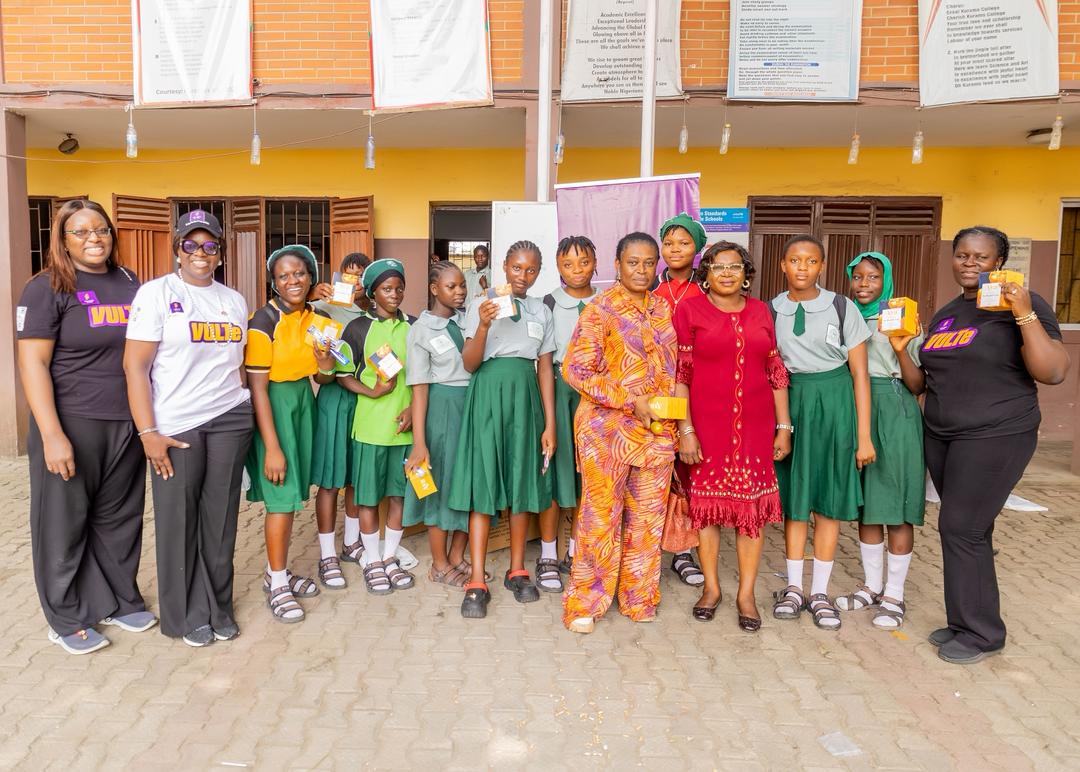
Polaris Bank Champions Girls’ Hygiene Awareness with Female Hygiene Essentials Distribution in Kuramo & Victoria Island Junior and Senior Secondary Schools
Polaris Bank has continued its commitment to empowering the Nigerian girl-child through health education and essential support, with the successful distribution of female hygiene essentials to female students of Kuramo and Victoria Island Junior and Senior Secondary Schools, Lagos.This initiative stems from Polaris Bank’s 2025 International Women’s Day celebration and forms part of our ongoing Adolescent Health and Hygiene Support Programme.Through the Bank’s Girl-Child Support and Hygiene Education Initiative, the outreach aims to improve menstrual hygiene education, build confidence and dignity among young girls, and reduce school absenteeism resulting from lack of access to sanitary products.Speaking at the event, Group Head, Customer Experience & Value Management, Polaris Bank, Mrs. Bukola Oluyadi, delivered a practical health talk to the girls, emphasizing the importance of maintaining proper hygiene during their menstrual cycle and in their daily lives.She advised the students on essential personal care practices including the appropriate use of sanitary pads, the importance of daily use of clean underwear, and maintaining good body hygiene with deodorants and regular washing, especially during puberty when their bodies are developing.“Your body is precious, and how you take care of it determines your confidence and wellbeing,” Mrs. Oluyadi told the students. “Good hygiene is not just about looking clean; it is about staying healthy, feeling comfortable, and showing up confidently in school and everywhere you go.”She also encouraged the girls to cultivate life-long healthy habits, be informed about their bodies, and speak confidently about their health needs.Also present at the distribution was the Non-Executive Director of Polaris Bank, Mrs. Subulade Giwa-Amu, who delivered a powerful motivational session on self-care, confidence, and self-presentation.In her address, she reminded the girls that taking care of their appearance and hygiene contributes significantly to building a successful future.“A clean girl equals a successful woman,” Mrs. Giwa-Amu affirmed. “Success is not only about your academic performance; it is also about how you present yourself. People see you before they know you, and first impressions always last. Loving yourself and caring for yourself should be a daily habit.”She further encouraged the students to build confidence from within, stay self-assured, and always be conscious of their personal hygiene as young girls stepping into womanhood.“Confidence starts with knowing who you are and being proud of yourself,” she added.“When you take care of your body, you build respect for yourself, and others see that confidence reflected in how you speak, walk, and show up in the world.”Polaris Bank’s support for the girl-child aligns with the Bank’s broader Sustainability and CSR strategy, which includes empowering young girls through education, access to essential learning materials, and social support systems that improve their health and academic performance.The Bank believes that sustained investment in girls’ wellbeing ensures equal opportunity, reduces school dropout rates, and helps drive long-term social and economic development.The female hygiene essentials distribution initiative directly addresses barriers that affect school attendance among adolescent girls, especially those who lack access to basic hygiene products.By equipping students with knowledge and materials, Polaris Bank is helping to normalize conversations around menstruation, reduce stigma, and support healthier outcomes for young girls.